
I have always been wildly clumsy when it comes to routines. The kind of person who won’t comb her hair for two days straight… okay fine, three… fine, four (but I promise not more than that), especially when deadlines collide with the very comforting chaos of WFH life. And yet, oiling my hair has always been my favourite form of self-care. I just never knew why. This conversation changed that. Somewhere between survival mode and shiny hair goals, I realised the real shift isn’t about products—it’s about consistency, gentleness, and what our habits say about how we value ourselves.
A conversation with Ssmile Hyatt—who began her career as a model on fashion week runways and beauty campaigns, and has since evolved into an actor, writer, painter, and modern-day wellness philosopher—helped me connect the dots.
Drawing from her psychology background and blending modern insight with Ayurvedic wisdom, Ssmile speaks about beauty as something that heals the mind, body, and soul (and when she’s not doing that, she’s meditating, dancing, playing chess, or writing poetry—casual genius energy). Her answers quietly made me pause and ask myself: Gauri, do you over-control everything around you or do you completely neglect yourself? To tweak a very wise line from Phoebe Buffay—I want to say, soft hair will come and go, but healing? Healing is for life.
And fair warning: Ssmile’s words might just convince you to set an alarm 30 minutes earlier and give yourself time to step into the chaos the day holds. Sharing key excerpts of our conversation.
Why do you think hair is often one of the first places people either neglect or over-control during stressful seasons of life?
Ssmile Hyatt (SM): This is really a two-part answer. Neglect often shows up during periods of stress or depression—not because we don’t care, but because our sense of self-worth quietly erodes. We begin to feel there’s no time, or that caring for our hair is an “extra” rather than essential. Other things take priority: work, travel, responsibilities. The unspoken belief becomes, my hair can wait, I can wait—the world must move before me. In that mindset, self-care starts to feel undeserved. Neglect, then, isn’t about hair alone; it reflects how we stop valuing ourselves, our routines, and even our nourishment.
Over-controlling, on the other hand, comes from a desire to project perfection. It’s rooted in the need to appear like everything is fine, even when we may be crumbling internally. This perfectionism drives the urge to control every detail—including hair—because showing vulnerability feels unsafe. While neglect and over-control may seem like opposites, they are deeply connected. One stems from low self-esteem and diminished self-worth, while the other arises from perfectionism—but both reflect our relationship with ourselves.

Many people describe returning to softness—brushing slowly, oiling, washing with intention—as a sign they’re finally out of survival mode. Why does that resonate with so many?
SM: Anything done with intention and softness is the opposite of survival mode. In survival mode, everything is fight, flight, or freeze. There is no space to sit calmly with yourself—these states exist on opposite spectrums. In survival mode, everything has to be fast because there’s an underlying fear of not being safe. But when you slow the body down, even slightly, and time begins to feel more still, the mind and body receive a signal: maybe I am safe, maybe I’m not in survival mode anymore. Whether intentional or not, as long as you’re moving with softness, you are no longer in survival mode.
That’s why this resonates with so many people—we’re all wired similarly. When one person says, “I just want to sit and relax for a while,” others immediately relate. Practices like brushing slowly, oiling, or washing with intention matter. When we’re rushed, we wash fast, comb wet hair harshly, and gain no relaxation or benefit for the hair. It’s the small things: remove urgency and give yourself time. Someone with higher self-worth will wake up half an hour earlier just to be considerate toward themselves.
What does “soft hair” mean right now, beyond trends or aesthetics?
SM: When I think of soft hair, I think of hair as it is. Growing up, we were fed images of super-shiny, perfect blowouts with not a single strand out of place—on paper, that may look like ideal soft hair. But for me, soft hair means natural hair: it might have a bit of frizz from the weather, it may not be perfectly uniform, but it’s still soft because it’s still hair. When I say soft hair, I often mean real hair—curly, wavy, frizzy, short, long—anything, as long as we are appreciating it and not trying to alter its chemistry to tick off some beauty box.
This reflects acceptance of oneself and valuing what our hair does for us and what it means. From there, everything feels softer. Life feels more romantic. By soft, I mean soft from a romantic lens—not exaggerated, not undervalued—somewhere in the middle, where you take care of your hair but don’t stress over it. If I’m running late, I might just braid it. That balance is the whole philosophy of soft hair.
Why do private beauty rituals—things done off-camera, without posting—feel more emotionally restorative than public-facing routines?
SM: I don’t think I relate to this question because when I’m filming my beauty rituals, I do them as they are. But I understand that for some creators, it may feel like they’re putting on a show for the camera, and doing the same thing off-camera feels different. That’s really a matter of camera and performance pressure that some creators place on themselves. My simple suggestion is this: at the end of the day, the root of any beauty ritual—whether skincare or oiling—is that you want to take care of yourself.
The second part might be that you also want to share your experience or expertise. I like to remind myself on camera why I’m doing a particular ritual: what’s the reason, the core of it? Usually, it comes down to either wanting to share or wanting people to know something specific. Focusing on that intention brings the same calmness and love I have off-camera.
How does touch in haircare (brushing, massaging, detangling) affect in ways people don’t always realise?
SM: Massaging the scalp is very important. There are marma (meridian) points on our scalp—an Ayurvedic technique that focuses on releasing stuck energies in the body and improving blood circulation. It also benefits the subconscious. I’ve been practising marma massage for many years, and I can personally feel its effects. Whenever someone is getting a massage or detangling their hair, these key points are being stimulated. You may not realise why you feel better afterwards, but this is one of the reasons. It’s a great way to drain off the negative energies that your body is sometimes holding on to.
There are other factors too. The neck and head are connected, and our neck often holds tension from stress or daily strain. Marma massage and gentle detangling take time, and in doing so, you are caring for your hair and yourself. For some, marma massage is an elaborate ritual; for others, it’s a daily routine they can’t skip. Either way, it has a meaningful impact on mental health, calmness, and self-perception.
Every action we take—often unconsciously—reflects our self-image and self-worth. Even small habits, like massaging or detangling, shape us. When you approach these rituals with the identity of the person you want to be, you naturally feel better. And while massaging, you also improve blood circulation and invite calm into the body—benefits many people don’t even realize.
There’s a lot of pressure to see immediate results in beauty. What shifts when people focus on gentleness instead of transformation?
SM: This is a big problem with social media and the overload of information—and misinformation—we face. There’s constant pressure to see immediate results. I don’t have a single solution for this; gentleness can’t be forced. You might be able to push it once or twice, but it won’t become a lifestyle. For gentleness to truly become part of your life, it has to come from your identity—an identity rooted in self-love, higher self-esteem, and a commitment to bettering yourself each day. That’s the small, sustainable shift.
Sudden transformations—going to the salon, chopping hair, coloring it—might feel satisfying initially, but they come with consequences. Gentleness, on the other hand, grounded in identity, calms not just the body but the nervous system. It reinforces self-belief: I am taking care of myself, which then reflects in work, relationships, and interactions. You can’t fake that aura. For someone transitioning from fast-paced survival mode to a gentler approach, small, intentional actions are powerful—they’re doable, sustainable, and far more effective than stress or shortcuts.
What role does consistency—small, repeated care—play in rebuilding trust with your body/hair?
SM: That is where everything is; it is what it’s about. If you really want to build trust in your body, hair, and skin, your body knows consistency and routine. The same goes for the mind. Sometimes, when routines are so hardwired, you may not even think of it, but you’re doing it. That’s what a habit is, and that’s how powerful a routine is.
Now, I can wake up every day and brush my hair, do my skincare, or I can try to do all of it in one day—it doesn’t make sense. In one day, it will never happen. And for hair, no matter what you do, the results will only show after three months. So the choice is really no choice at all. You do not have a choice when it comes to hair.
If you genuinely want to see a big result in your hair, give it 3 to 4 months of consistently eating right, sleeping right, maintaining a good lifestyle, and doing your champi—and then see the results for yourself. That is just like basic facts, right? I don’t know if it is basic facts for everybody. I mean, you have to check your deficiencies and visit your doctor, but anything in hair takes 3 to 4 months to show real results. Consistency is everything. It’s not a choice in this matter. It is everything.
In your view, why are so many people drawn back to oils, brushes, and slow routines right now? What need is that responding to?
SM: The whole country is coming back, not only to its roots, but there is also a sense of pride in the Indianness of everything. Social media and creators are sharing experiences, so there is more curiosity around it. It’s happening in two ways: people are really coming back to their roots, feeling pride in Indian rituals, and secondly, because we’ve seen others share their experiences, we want to try it ourselves.
Maybe we’re also done with chemically transformed, fast-result, marketing-driven products, and we’re saying, “No, give it to me in real terms.” There is a huge shift, and I’m happy it’s happening. I cannot wait to see where it goes because these rituals are something I love and always promote.
What’s one everyday hair habit that people underestimate, but that often signals a deeper shift?
SM: For me, I would say the nightly tying of a loose braid—that’s something I’m not sure if everybody does, but I do it every night. I use silk pillowcases and silk bonnets every night. During the day, I eat walnuts, fatty acids, and proteins, and I do this consistently every day. I’m seeing that it all comes from identity. It all comes from the smaller habits that form identity, and then identity is reinforced by the new actions we take.
Even small acts, like brushing your hair at night and putting it in a loose braid, do something to your brain. In those few moments, at least for me, I am not looking at my phone. I don’t care what’s happening outside of the four walls of my room—I am genuinely present with my hair. It’s a very simple act, almost meditative. Because I also practice meditation, I’ve noticed that you may try everything in life, but if you’re not following through with these small habits—covering your hair with a scarf, avoiding too much heat, eating right—nothing will work.
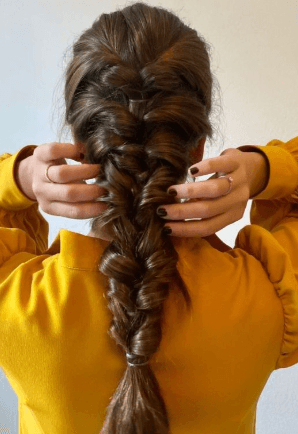
The deeper shift is realising that I do not have to change everything about myself to fit into some standard. I can just show up for myself every day, love myself a little, even if I don’t have time for a lot. For someone with limited time, committing to those five minutes is enough. The shift is huge—you see it in your body, feel it in your aura. People around you start noticing. I can’t point it out, but it’s this energy—you are pouring into yourself. And that’s the biggest gift any woman can give herself.
Also Read:
I tried the viral Korean hair spa at Lakme Salon
5 proven tips for hair growth
7 best champi oils for strong and healthy hair