My grandmother had the most luscious hair of her time—the kind that turned heads and set unspoken standards at family gatherings apparently. Which means, naturally, I’ve inherited the responsibility of keeping my own hair in top form, purely to keep the family competition alive. But somewhere between highlights, global colours, and miracle products, we’ve collectively forgotten one inconvenient truth: the scalp is the root of it all. If your scalp isn’t happy, your hair will absolutely snitch on you. Think about it—do you only spray the leaves of your plants and hope for the best, or do you water the soil, add fertilisers, and actually care about what’s happening underneath? So why do we treat our hair any differently?
Lately, my Instagram feed has been flooded with Korean hair spas, steamy scalp rituals, and people emerging looking suspiciously calm and glossy—and I can’t shake the feeling that I’m missing out. To really understand what the scalp needs, why massage matters, and what makes Korean treatments so transformative (yes, I’m booking one soon), I dove into a fun Q&A with Jashmina Jain, Associate Director at Florian Hurel Hair Couture & Spa.
Meet the expert: As Associate Director at Florian Hurel Hair Couture & Spa, Jashmina brings over 2 decades of mastery to the salon floor. Renowned for her precision cuts and bespoke color, her approach is rooted in a deep understanding of hair texture and evolving trends.
With over 20 years of hands-on mastery, she’s known for her precision cuts, bespoke colour, and deep understanding of hair texture and trends—while also mentoring the next generation and helping run the business behind the scenes. Her answers didn’t just teach me about scalp care; they made me seriously question my hair habits, my intentions, and how much care I’ve been giving the place where it all actually begins.
Lavenderoom: Many people focus on hair results—length, shine, thickness. From a professional standpoint, why does scalp health deserve more attention than the visible outcome?
Jashmina: Visible results like shine and length are symptoms of a healthy system. If you chase the symptom without treating the source, you’ll eventually hit a “growth ceiling” where the hair breaks or thins regardless of how many masks you apply. Prioritising the scalp ensures that the hair coming “off the assembly line” is the strongest version of itself from day one.
Lavenderoom: How do touch and massage during scalp treatments affect more than just circulation—what do you see happening for clients emotionally or physically?
Jashmina: When a client says, “That was the best part of my week,” they aren’t talking about the shampoo. They’re talking about the fact that for 10 minutes, they didn’t have to carry the weight of their own head. By the time I get them back to the chair for the blowout or any service , the hair is more “pliable” because the client is more pliable. A relaxed scalp grows better hair, sure, but a relaxed client is a loyal client for life.
Lavenderoom: In your experience, how does consistent scalp care function as a form of self-soothing or grounding, especially for clients dealing with stress or burnout?
Jashmina: I’ve noticed that for clients dealing with heavy burnout, their scalp actually feels “tight” to the bone. It’s like their skin is reflecting their mental state. As that scalp loosens up through consistent care, you often see their whole demeanor soften. They start making eye contact again. They start smiling. It’s not just about the hair; it’s about reclaiming the headspace.
Lavenderoom: Oils have been used in hair rituals across cultures for centuries. What role do oils play in modern scalp health, and why do you think they feel so comforting?
Jashmina: The Professional “Secret” Why does it feel so good when a pro does it? It’s the temperature. Warm oil lowers the viscosity, allowing it to penetrate the follicular openings more easily, but it also mimics body heat. This “thermal touch” reminds the nervous system of human-to-human bonding (like a parent oiling a child’s hair), which is one of the most powerful anti-anxiety signals we have.
Lavenderoom: What are some signs that someone’s scalp is asking for care—even if their hair “looks fine” on the surface?
Jashmina: The “Pinch Test”
Here is a pro trick: Try to gently “pinch” the skin on the top of your head.
• If the skin moves freely, your scalp is relaxed and healthy.
• If it feels tight, “glued” to the bone, or won’t budge, your scalp is under extreme tension. That lack of mobility means blood isn’t reaching the follicles effectively.
It’s also called scalp aging.

Lavenderoom: Your salon offers a Korean spa experience. Can you explain how Korean scalp and spa traditions approach healing differently than basic haircare practices?
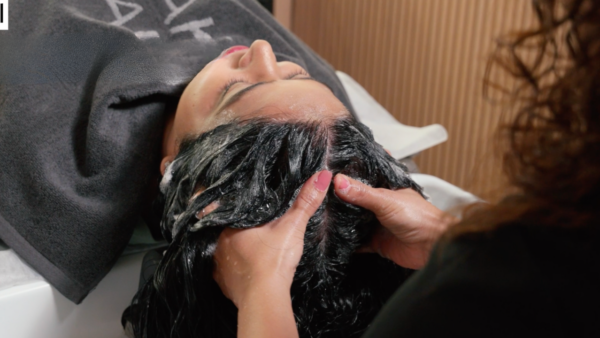
Jahmina: The Korean approach recognizes that hair loss and scalp issues are often “emotional symptoms.” By spending 60 to 90 minutes on the scalp alone, we are telling the client’s nervous system that it’s okay to let go. When the scalp is relaxed and the pores are clear, the hair that grows out is a reflection of that peace.
Lavenderoom: What elements of the Korean spa—steam, exfoliation, massage, water—are especially beneficial for scalp health, and why?
Jashmina: If you only do one of these, you’re missing the point. If you exfoliate without steaming, you’re being too aggressive. If you massage without clearing the buildup, you’re just rubbing oil into clogged pores. The Korean method works because it respects the biological order of the skin.
Lavenderoom: Clients often describe spa scalp treatments as deeply calming. What’s happening physiologically during these experiences that makes them feel so grounding?
Jashmina: I often tell clients that a scalp treatment is like a “Hard Reset” for a computer that’s been running too many tabs. We aren’t just cleaning hair; we are clearing the “cache” of the nervous system. The grounding they feel is simply their body returning to its natural, baseline state of safety.
Lavenderoom: How do you guide clients to continue scalp rituals at home without turning them into another task or performance of “self-care”?
Jashmina: I tell my clients: “The most effective scalp care routine is the one you actually enjoy doing.” If a 14-step Korean-inspired routine makes them feel stressed, it’s actually counterproductive for their hair because it’s raising their cortisol.
The goal is to make the scalp ritual the period at the end of a long sentence—a place where the day finally stops.

Lavenderoom: For someone new to scalp rituals, what’s one small, tactile practice you’d recommend to help them reconnect with their body through haircare?
Jashmina: Ritual over Performance
The goal is to provide a “period at the end of a sentence”—a definitive stop to the day’s stress.
• Tempo is Everything: The effectiveness of a ritual is determined by speed. Slowing down the movements tells the brain it is no longer in a rush.
• Sustainability: A 14-step routine that causes stress is counterproductive. The best routine is the one the client actually enjoys, as it keeps cortisol levels low and consistency high.
Scalp care is the management of emotional and biological symptoms. When we clear the pores and relax the fascia, the hair becomes a reflection of that internal peace.
Also Read:
5 proven tips for hair growth
9 champi oils for string and healthy hair
I tried the viral Korean spa at Lakme Salon, here’s what really happaned