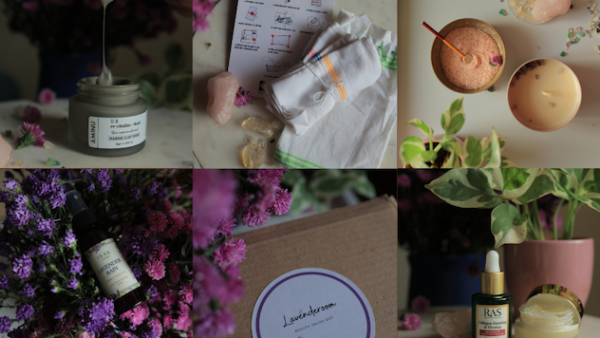

Long before “clean beauty” became a shelf category in India, Juicy Chemistry was quietly doing the unglamorous work of getting it right, eventually pursuing COSMOS certification at a time when most brands were still relying on the word “natural” printed on a label.
Founded in Coimbatore in 2014 by husband-and-wife duo Megha and Pritesh Asher, the brand grew out of a very personal frustration: Megha’s own struggle with hormonal, acne-prone skin, and Pritesh’s recognition of familiar industrial raw-material categories on the ingredient list of a product being positioned as natural. What followed was a brand built around questioning labels, understanding ingredients and eventually putting its organic claims through an independent global standard. Juicy Chemistry achieved full Ecocert COSMOS certification in 2017. Twelve years on, Megha’s gaze has widened beyond ingredient lists to something more urgent: what beauty culture is now selling to children, and what it means to raise a daughter inside an industry increasingly shaped by manufactured inadequacy.
You started off studying criminology, then worked as a journalist, before Juicy Chemistry. How did that path, investigating, questioning, following evidence, shape the brand’s obsession with ingredient transparency?
Megha: I think questioning things has always come naturally to me, and my background probably strengthened that instinct. Criminology taught me to look beyond the obvious narrative, and journalism taught me to keep asking questions until something actually made sense. But with Juicy Chemistry, it became very personal.
I had struggled with PCOD and the skin issues that came with it for years. I had been to dermatologists, taken oral medication, used prescription treatments and tried pretty much everything I was told would help. Eventually, I reached a point where I thought, maybe I should simplify things and try going completely natural. Except when we actually started looking at the products I thought were natural, we realised many of them weren’t quite what I had assumed them to be. That was really the beginning of everything for me. I started turning products around and reading ingredient lists. What is actually in this? Why is it here? Does the formulation match what the front of the bottle is telling me? I wasn’t a cosmetic chemist, and I didn’t pretend to be one.
I was a frustrated consumer who had started asking better questions. And I think that has stayed with Juicy Chemistry ever since. Transparency for us wasn’t born out of a marketing strategy. It came from wanting the information I wish I had been given as a consumer.

Juicy Chemistry was born out of Pritesh recognising petrochemical raw materials on the back of a so-called “organic” product. What did that moment reveal to you both about how the word “natural” was being used in Indian beauty at the time?
Megha: It was quite an eye-opener because I genuinely thought I was about to make the switch to natural. We were at a mall and I had picked up a product that was being sold as natural. Before I bought it, Pritesh turned it around and started reading the ingredient list. Because of his family’s background in industrial raw materials, he recognised several of the ingredients and questioned how the product was being positioned. I didn’t buy it. But more importantly, we went home with a lot of questions.
We started turning over other products and realised there was a huge gap between what was being communicated on the front of the pack and what was actually in the formulation. Botanical imagery, a hero natural ingredient and words like natural, herbal or organic could create an impression about the entire product that the ingredient list didn’t necessarily support.
There have definitely been changes in the last twelve years. Consumers are far more aware, certifications are better understood, and brands are being questioned much more closely. But even today, these terms can be used very loosely. A botanical ingredient in a formulation doesn’t automatically make the formulation natural, just as calling something organic doesn’t tell you how much of it is actually organic or according to what standard.
For us, that moment became much bigger than natural versus synthetic. It became about whether what a brand says on the front of the bottle can be substantiated by what is on the back. And that question still holds today.
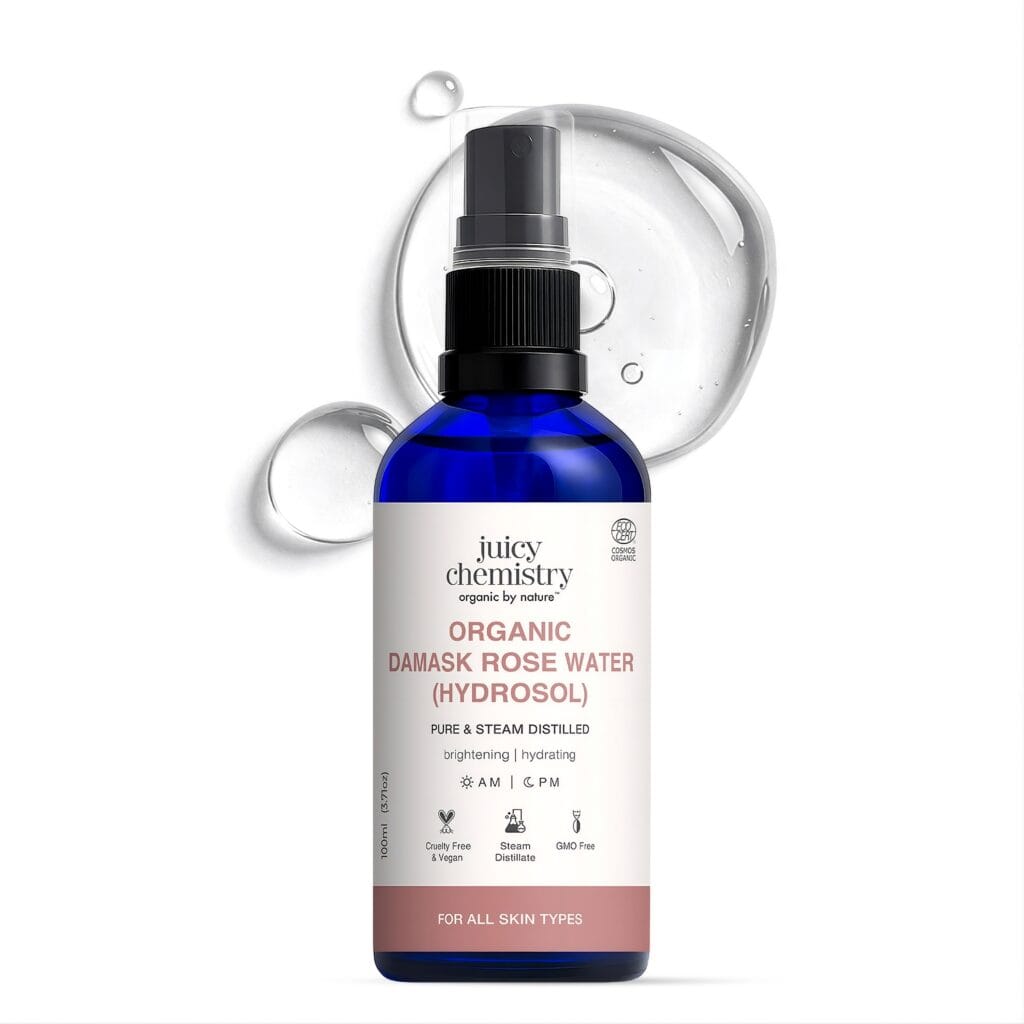
You became India’s first COSMOS-certified organic skincare brand. Certification is expensive, slow, and largely invisible to the average buyer. Why did you decide it was non-negotiable rather than a nice-to-have?
Megha: When we were building Juicy Chemistry, one of the biggest questions we would get while standing at markets and exhibitions, talking directly to consumers, was, “How are you different from XYZ Ayurvedic brand?” or “How are you different from all the other natural brands out there?” And it was actually very difficult to explain that difference in simple terms. We could tell someone that a product was water-free, that we weren’t using certain emulsifiers or additives, or explain how we were sourcing and processing an ingredient differently. But for an average consumer standing at a stall, those explanations only went so far. At the end of the day, it was still us telling them that our definition of natural or organic was somehow different from somebody else’s.
So we started asking ourselves: how do we prove it? After a lot of research, we realised that the answer was to work towards an independent global certification standard. That way, we weren’t creating our own definition of organic. There was an external standard defining what was permitted, how ingredients had to be sourced and documented, how products were manufactured, and what we could actually claim.
Getting there was a very long journey. At the time, almost nobody we spoke to in India had heard of these certifications. Many of our vendors and suppliers didn’t have the documentation or certifications we required, so it wasn’t simply a matter of submitting our existing products and getting a stamp. We had to work backwards through the entire supply chain. It was expensive and difficult, but that was also precisely why it mattered.
Certification gave us an independent way of answering that question we kept hearing at those markets: “How are you different?” We didn’t have to just say it anymore. We could prove it.
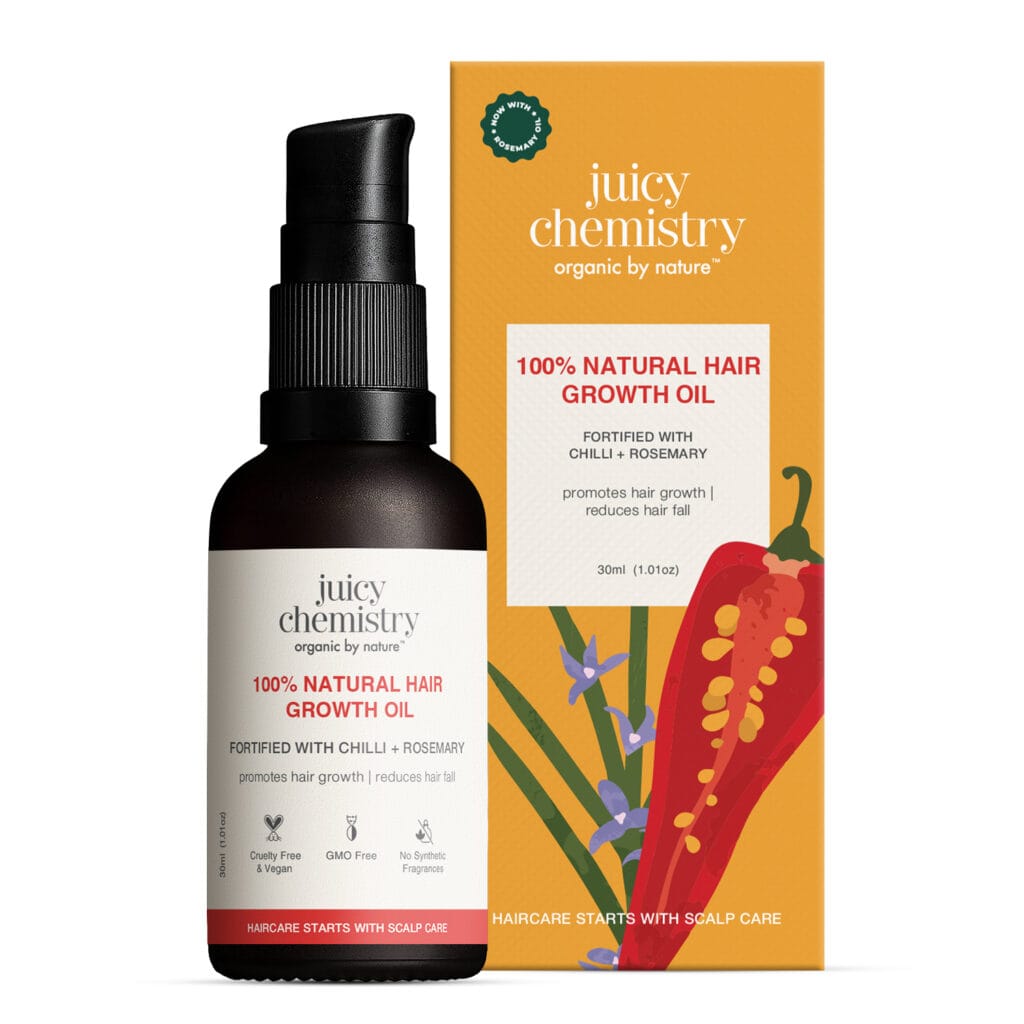
Long before “clean beauty” was a buzzword here, you were talking about essential oils and actives in scientific, almost clinical language, not the “nani-dadi nuskha” framing most Indian brands leaned on. Was that a conscious positioning choice, or just how you naturally think about formulation?
Megha: I don’t think it started as a conscious positioning choice. It came from being genuinely curious about why an ingredient worked.
We have an incredible history of using botanicals in India, and I have enormous respect for traditional knowledge. But when we started Juicy Chemistry, I didn’t want the conversation to stop at, “This has been used for generations, therefore it works.” I wanted to understand what was actually happening within that ingredient.
Why is rosehip oil different from another plant oil? What does its fatty acid profile look like? What happens to an oil when you heat it during extraction? What are the constituents of an essential oil, and at what concentrations should it actually be used? The deeper we went into formulation, the more fascinating that became.
Essential oils are a great example. They have been incredibly polarising in skincare. One side swears by them because they’re natural, while the other believes they have absolutely no place in skincare. I don’t think either extreme tells the full story.
Like any ingredient, you have to understand its chemistry, its purpose in a formulation and, critically, its dosage. Dosage is at the core of formulation. The more useful question isn’t simply, “Should I eliminate this ingredient?” It is, “Why is it here? How much is being used? And is it appropriate for this formulation and this skin?”
Individual skin response matters too. Someone with very sensitive or reactive skin may need to avoid essential oils or fragrance. But sensitivity isn’t exclusive to one category of ingredients. Even something as seemingly simple as aloe vera may not suit everyone. That doesn’t make aloe a bad ingredient. It means skin is individual.
I think beauty has become too comfortable putting ingredients into absolute buckets: natural versus synthetic, good versus bad. Formulation is far more nuanced than that. Science and nature aren’t opposing ideas. For us, science has always been the way to understand nature better.

Being based in Coimbatore rather than Mumbai or Delhi, has that shaped the brand’s identity, pace, or relationship with sourcing and manufacturing in ways a metro-based label wouldn’t have?
Megha: Absolutely, although it wasn’t a strategic decision. Coimbatore was home, so that is where Juicy Chemistry started. In hindsight, though, I think building the brand here shaped us enormously. Coimbatore is a very manufacturing and entrepreneurial city. There is a culture of making things here, of understanding machinery, processes, raw materials and supply chains. That naturally influenced the way we built Juicy Chemistry.
We also chose very early on to manufacture ourselves rather than outsource production. That meant formulation and manufacturing weren’t sitting somewhere far removed from the brand. We were in the factory, dealing with batches, sourcing issues, stability, machinery and all the very unglamorous realities of actually making a product.
Being outside Mumbai and Delhi probably insulated us from the beauty industry in some ways too. When we started, we weren’t surrounded by other beauty founders, investors or trend conversations. We were largely figuring things out ourselves. There were disadvantages. Access to talent was harder, networking was harder, and for a long time almost every important industry conversation seemed to happen somewhere else.
But it also gave us the space to build differently. Juicy Chemistry has always been a product and manufacturing-led company before it became a beauty brand, and I think being built in Coimbatore has a lot to do with that.

You and Pritesh are partners in life and business. How do you divide the emotional, creative, and scientific labour of running Juicy Chemistry, and where do you disagree?
Megha: We are actually quite clearly divided in terms of what naturally excites us.
Ingredient research is my passion and probably my obsession. I can spend hours going down a rabbit hole on an ingredient, understanding its chemistry, how it is processed, what the research says, what changes at different concentrations and whether the claims being made around it actually hold up. That’s where I channel a lot of my energy.
And because I have done that research myself, being consumer-facing comes very naturally to me. Whether it is on social media, at an event or answering a consumer question, I can explain why we’ve chosen an ingredient, what we expect it to do and why we’ve formulated a product the way we have. I’m not communicating something that has simply been handed to me by a product team. I’ve usually spent months researching the thinking behind it.
Pritesh takes that thinking into a very different world. He leads R&D and manufacturing and is deeply involved in formulation, processes, machinery, production and the technical problem-solving that goes into taking something from an idea to a product that can actually be made consistently and at scale. He is also far more involved in the administrative and structural side of running the company.
And I think that part is often invisible from the outside. Developing a formulation is one thing. Making sure it remains stable, performs consistently from batch to batch, works with your manufacturing process, meets certification requirements and can eventually be produced at scale is an entirely different challenge. That is very much Pritesh’s space.
So there is a natural handover between us, but also a lot of back and forth. I’ll become obsessed with an ingredient and want to explore what we can do with it. He will immediately start questioning how it behaves in a formulation, whether it is technically viable and how we would actually manufacture it.
We disagree often, which I think is healthy. I can get very attached to the potential of an ingredient; he can be the person telling me why it isn’t going to work the way I imagine it will. And sometimes I push him to keep trying. After twelve years, we’ve learnt to trust what the other person brings to the table.
I think Juicy Chemistry works because neither of us is trying to do the other’s job. I obsess over the ingredient and the consumer; Pritesh obsesses over turning that thinking into something we can actually make, consistently and well.
You’ve been vocal recently about “Cosmeticorexia” and the Sephora Kids phenomenon, skincare marketed to children who don’t need it. What worries you most about how beauty culture is reaching younger and younger girls?
Megha: What worries me most isn’t actually the skincare. It’s what we’re doing to the psyche of children before they have even had the chance to develop a healthy relationship with their face and body. I’ve been researching and writing about something I call manufactured inadequacy: the way industries can first make you conscious of a flaw, sometimes one you had never noticed before, and then sell you the solution to it.
Beauty has always done this to adults. What is deeply uncomfortable now is how early that cycle is beginning.
A nine or ten-year-old today isn’t only looking in a mirror. She is looking at herself through filters, AI-enhanced faces, edited images and an endless feed of people who appear to have poreless skin, perfectly symmetrical faces and no texture at all. There is growing research around appearance-focused social media, filters and photo editing and their relationship with appearance comparison and body dissatisfaction among young people. What makes filters particularly unsettling is that a child can now compare her real face not only with somebody else’s, but with an altered version of her own face.
And then the beauty industry comes into that environment and sees a new consumer segment. That is where I think we need to have a much more uncomfortable conversation about corporate responsibility. Children are not a market-size projection or the next generation of lifetime consumers. The fact that there is commercial opportunity does not mean every opportunity should be pursued.
We are already seeing dermatologists raise concerns about pre-adolescents experimenting with acids, retinoids and trend-driven routines their skin may not need, while regulators and advertising bodies in different markets are beginning to look more closely at how beauty products are marketed to minors. So I don’t think brands can simply say, “The consumer wants it, therefore we will make it.” We also have to ask how that demand was created in the first place.
If a child believes at ten that her pores need minimising, her skin needs brightening, her face needs sculpting or that she needs to start preventing ageing, that isn’t simply a successful new beauty category. We need to question whether we are witnessing corporate harm in the making.
And I say this as someone who has spent twelve years inside the beauty industry.
We cannot demand responsibility from social media platforms, influencers, parents and children while exempting the companies that design, market and profit from these products. There has to be restraint. Children are not numbers on a market-sizing slide. They are children. And an industry that makes money from how people feel about themselves has an even greater responsibility not to teach them inadequacy before they are old enough to recognise that it is being sold to them.
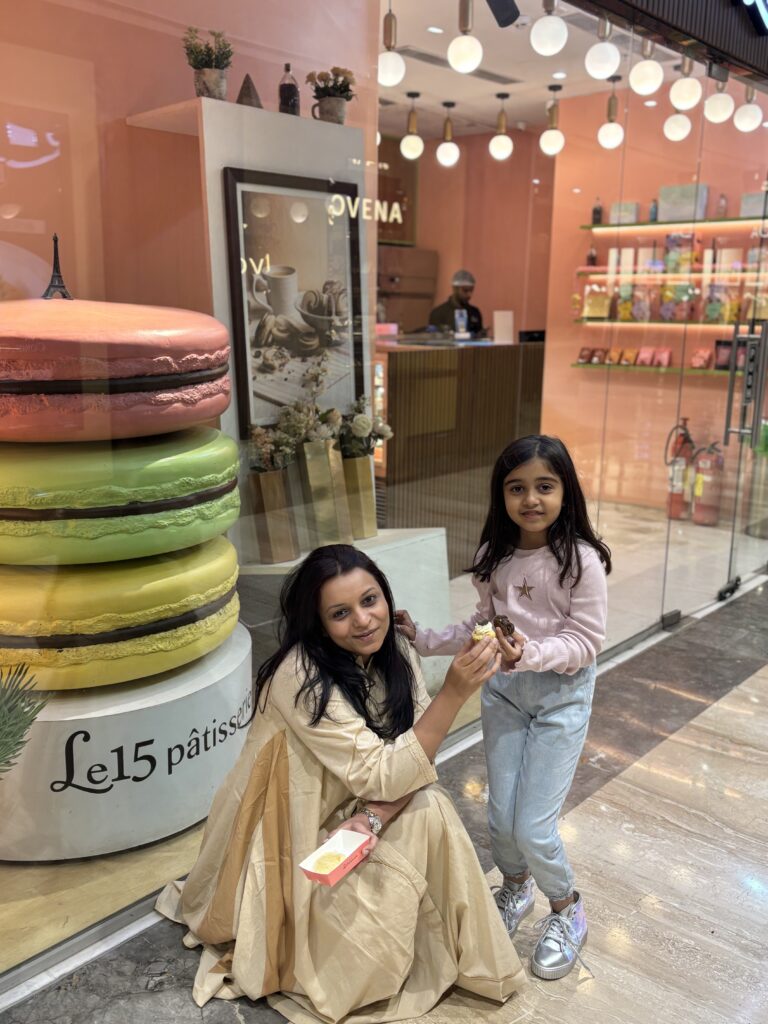
You’ve spoken about teaching your daughter to read labels, on skincare and beyond, as one of the most useful habits you could give her. What does that conversation actually look like at home?
Megha: My daughter has quite literally grown up at work. Juicy Chemistry has existed for longer than she has, so ingredients, formulations and conversations about why something is made a certain way have always been around her.
But interestingly, reading labels with her didn’t really start with beauty. It started with food. From quite young, we would turn a packet around and look at what was actually inside it. Not to tell her, “This is bad, don’t eat it,” but to help her understand what she was choosing and eventually be able to make better decisions for herself.
Beauty entered that conversation much earlier than I expected. When she was about six, she came home from school one day and said, “Did you know you can make curls with a pencil?” A friend had seen a reel showing how you could wrap your hair around a pencil and use a blow dryer to curl it. That stayed with me.
My daughter wasn’t being given a phone or scrolling through social media herself. And yet social media had still reached her. One child sees something, brings it into a classroom, and suddenly an idea from a reel becomes part of the conversation between six-year-olds.
That was when I realised I couldn’t approach this by simply controlling her screen time. I needed to prepare her for the environment she was growing up in.
So, as she’s grown older, our label conversations have naturally moved from food into beauty and advertising. We talk about what a product says on the front versus what is actually inside it. Why is everyone suddenly talking about a particular product? Is someone recommending it because they genuinely like it, or is it advertising? Do you actually need what they’re telling you that you need?
I don’t want her to fear beauty, ingredients or even social media. That’s not the answer. I want her to enjoy these things while understanding how they can influence her. Because she’s nine now, and I know I can’t curate the world around her forever.
I would much rather teach her how to question what reaches her than believe I can stop it from reaching her at all.

If a mother came to you asking what her 12-year-old actually needs on her skin, what would your honest, un-marketed answer be?
Megha: Honestly, very little. At twelve, skincare should be about basic hygiene, protection and understanding your skin, not building a routine because social media tells you that you need one. If the skin is healthy, a gentle cleanser, a simple moisturiser and sunscreen are really the basics. That’s enough.
Of course, puberty changes things. Hormones can bring oiliness, blackheads, acne and other concerns, and I think those should be addressed when they actually appear rather than pre-emptively treating a child’s skin for problems she doesn’t have. If there is persistent or severe acne, I would much rather a parent take the child to a dermatologist than have them experiment with a cocktail of trending actives.
What concerns me today is the idea of preventive skincare being pushed younger and younger. A twelve-year-old doesn’t need anti-ageing. She doesn’t need to minimise pores that are a completely normal part of skin. She doesn’t need a weekly exfoliation schedule or five different serums. And I would say the same thing even though I run a skincare company: please don’t buy your child a product simply because we, or any other beauty brand, have convinced you that she needs it. Buy something because there is a genuine need for it. I also think this is an important age to change the language around skincare.
Instead of asking, “What do we need to fix?”, perhaps we should be teaching children, “What does your skin need to stay healthy?” Those sound like very similar questions, but psychologically I think they are completely different. A child’s first relationship with skincare should be about caring for her skin, not correcting it.

Twelve years in, organic and “clean” beauty in India has gone from niche to a crowded marketplace. What’s changed for the better, and what trend right now makes you want to turn the bottle around and read the back label?
Megha: When we started, we had to convince people to even read an ingredient list. Today consumers come to us knowing ingredient names, asking about percentages, clinical studies, certifications and sourcing. They’re curious, they’re researching, and they’re asking brands much harder questions. I think that’s fantastic.
But beauty also has this incredible ability to keep finding new language to sell you essentially the same idea. At one point everything was natural. Then it became clean. Then non-toxic. Today we have science-backed, dermatologist-approved, clinically proven. And now percentages are everywhere. Put 10% or 15% in very large type on the front and immediately it feels more efficacious.
I’m not saying these things don’t matter. Of course they do. We use actives, percentages and clinical testing ourselves. But I think we’ve reached a point where consumers need to question those claims too.
If you tell me something is clinically proven, my immediate question is, what was clinically proven? Was it this actual product? Was it the ingredient? What was tested and on how many people?
The same goes for organic. Organic according to whom? To what standard? How much of the formulation is actually organic? I think that’s probably the biggest change for me personally. Twelve years ago, I was turning the bottle around because I didn’t necessarily trust the word natural. Today, I’ll turn it around when I see a very impressive scientific claim too.
Because ultimately, marketing changes. The questions shouldn’t. What are you actually selling me? And can you back up what you’re saying?
Lavenderoom’s philosophy is “Beauty Inside Out”, that the body is the bridge between mind and spirit. Where does that idea show up in how you think about skin, formulation, or even the way you’re raising your daughter around beauty?
Megha: This one is very personal for me because my own relationship with beauty didn’t start from a particularly healthy place. I had PCOD. I dealt with acne, pigmentation, facial hair and weight fluctuations, and for a very long time I saw all of those things as problems with the way I looked. I tried to fix the acne, fix the pigmentation, lose the weight. It took me much longer to understand that my skin wasn’t existing independently of everything else that was happening in my body.
And I think that’s changed the way I look at beauty today. Skin is connected to hormones, stress, sleep, nutrition, genetics, environment and age. Of course, skincare has a role, and I have spent twelve years building products because I believe very strongly in what good formulations can do. But a serum cannot fix your relationship with yourself. And I think sometimes the beauty industry quietly allows people to believe that it can. Becoming a mother has made me even more conscious of that.
I want my daughter to enjoy beauty. I don’t want to raise her believing that caring about how you look is somehow superficial or wrong. Beauty can be fun, creative, expressive, even comforting. What I don’t want is for beauty to become the measure of how she feels about herself.
And perhaps that’s what “Beauty Inside Out” means to me. Take care of your skin, take care of your body, enjoy beauty, use the lipstick, do your hair. Just don’t spend your life believing that you need to keep fixing yourself to be enough.
For me, there is a very important difference between self-care and self-correction. I hope that’s the difference I’m able to teach my daughter too.
What stays with you after talking to Megha Asher is her refusal to separate the personal from the principled. The same instinct that made her question a label in a mall twelve years ago is the one now shaping the conversations she has with her daughter about labels, marketing and self-worth.
Juicy Chemistry’s story is, in the end, about more than organic certification. It is about a certain kind of attention: reading closely, asking why, and not accepting an answer simply because it is well packaged.