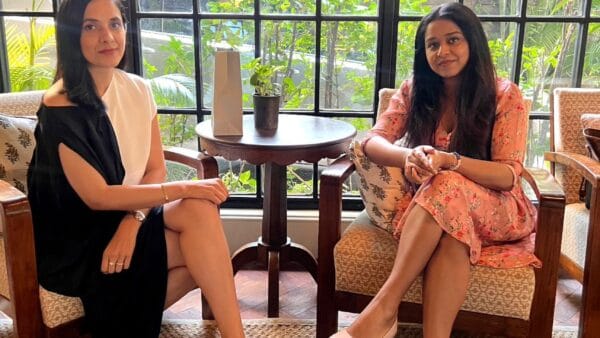

In this Lavenderoom guest author essay, Surbhee Grover, founder of Love, Indus, shares five lessons her travels taught her about building a luxury beauty house.
When people ask me where Love, Indus was born, they expect me to name a single coordinate on a map. The truth is, it was born in transit — between the sun-bleached roads of regional India, corporate boardrooms in New York, and late-night subway rides across Manhattan.
As a first-generation immigrant and founder, my journey hasn’t been a straight, tidy line; it is a rich, textured collage. Traveling between vastly different cultures didn’t just shape my worldview — it built the operational, creative, and sensory foundation of my brand.
Here are five lessons my travels taught me about building a global luxury beauty house on my own terms.
1. The Place: Sensory Maximalism in Rajasthan
Growing up in Kolkata, my world expanded every summer when we traveled to Ajmer, Rajasthan, to my nani’s house (my grandmother’s home). Life there was pure sensory maximalism. It was the syrupy sweetness of ripe mangoes dripping off our hands, the vivid jewel tones of homemade sherbets, and the crackle of old Bollywood records playing in the background, brought to life by my mother’s music-loving family.
Everything was seen, felt, heard, and tasted deeply. Yet, amidst the beautiful chaos — including twenty-one first cousins sleeping side-by-side on the open rooftop under a blanket of desert stars — there was an undeniable harmony. That summer rooftop taught me early on that true luxury isn’t sterile or quiet. It is sensory, deeply emotional, and steeped in communal warmth — a philosophy of rich texture and soul that now defines every Love, Indus creation.

2. The Ingredient: A Mother’s Golden Muga Silk Sari
My discovery of golden Muga silk didn’t happen in a sterile laboratory; it started in a quiet, intimate moment back in India, watching my mother gently unfold her heirloom Muga silk sari. Decades had passed since my childhood, but the sari hadn’t dulled. Its strength hadn’t wavered; it was still golden, resilient, and glowing. Native to Assam, Muga silk is one of the strongest natural fibers in the world — a rare, protein-rich fiber historically reserved for royalty that doesn’t wear out, but wears in.
Watching how that fabric refused to fade with time, the sari became more than a memory — it became a muse. I began to look at it through a modern beauty lens: why couldn’t the liquid strength and luminous resilience of this golden silk be unlocked for the skin? By liquefying those rich silk proteins and blending them with cutting-edge New York biotech, our flagship Amrutini® Collection was born. It proved to me that travel isn’t just about moving across physical borders — it’s about traveling between generations, taking raw cultural legacy and transforming it into high-performance clinical luxury.

3. The Outsider’s Eye: Seeing the Full Spectrum of India from New York
Living inside a culture can make you blind to its extraordinary nature because its richness simply feels like background noise. My experience of India was never monolithic — I grew up in Kolkata with roots in Punjab and Rajasthan, lived in Delhi and Mumbai, and spent my early career selling hair care products on rural dirt tracks, traveling deep into southern India and rural heartlands. Living across such distinct regions gave me a firsthand view of a vast, incredibly diverse tapestry of regional rituals and rare ingredients that went far beyond what the outside world knew.
Yet, it wasn’t until I moved to New York, earned my MBA at NYU Stern, and spent over a decade advising C-suite executives at global personal care brands across Europe and the US that my perspective fully crystallized.
From the outside looking in, I saw a massive gap: the global beauty industry was deeply reductionist. They took a sophisticated subcontinent filled with hyper-regional mastery and flattened it into a single shorthand — kitchen-cupboard Ayurveda, turmeric, and coconut oil.
Living in New York gave me the distance and strategic clarity to realize that my deep, personal immersion across India’s regions wasn’t just a collection of memories — it was a blueprint. I saw that South Asian beauty didn’t need to be simplified into a basic wellness trope or treated like a historical artifact. It deserved to be elevated into an opulent, high-tech global luxury standard — one that now sits proudly on the shelves of Macy’s, Nordstrom and QVC, and in luxury spas at the St. Regis, Four Seasons and The Hermitage, among others.
4. The Patience: Sowing Seeds in Unfamiliar Soil
When you travel into new territories — whether launching on national television like QVC or opening new retail channels — momentum rarely happens overnight. In the early days, I burned so much energy worrying during quiet periods, mistaking silence for stagnation.
Building across borders teaches you the art of seed-sowing. When you plant something in unfamiliar soil, nothing visible happens on the surface for months. Perfecting custom supply chains, establishing trust with specialized international labs, and cultivating retail partnerships require a long, quiet gestation period.
Love, Indus launched in 2021. It took three more years — and months of QVC onboarding, from clinical trials to custom packaging to new creative built to exacting guidelines — before we went live on November 1, 2024, as the first South Asian-inspired luxury skincare brand on the network. Then, in about eleven minutes, all 1,250 units of our Amrutini® Luminosity Dewdrops were gone. Those eleven minutes had been years in the making.
I learned to stop panicking during the quiet phases and trust the invisible work happening beneath the surface long before it becomes a sold-out broadcast.

5. The Collage: The Contrast IS the Secret Sauce
For years, I felt a subtle pressure to streamline my narrative — to make my path look like a neat, linear progression. I worried about how to reconcile selling hair care products on rural dirt tracks in India with advising C-suite executives in Manhattan boardrooms.
Travel breaks the illusion that life must be lived in a straight line. Crossing borders teaches you that contrast is where magic lives. My story didn’t need a single, neat string to tie the chapters together… it was a collage all along. The grassroots understanding of raw Indian heritage gave me heart, while my years in NYC strategy gave me the commercial muscle to scale.
Once I stopped trying to edit out the contrast and leaned into the full, vibrant spectrum of my journey, Love, Indus found its true voice: an opulent love letter to both of my homes, India and New York.
Also Read:
5 Beauty Routines I Didn’t Know I’d Inherit From My Mother
Decoding The Hype Behind Hydrafacial: Who Actually Helps, and Who Should Avoid It
5 Green Flags to Be in a Relationship with Your Skin