In the spirit of Durga Puja being just a few days away, I have mailed my clients that this girl is O-O-O, because she is on a week-long “festive break”. The Bombay hustler that I am, guilt and panic begin to push the heart rate monitor on my fitness-watch up. “There is still time to rescind that email…” a voice says.
And then my phone pings. It’s the Pujo Gang. “Hey, what time is the pushpanjali on Saptami?” Another asks, “Dinner post Ashtami, as usual, yes?”
Well, of course, yes. Durga Puja with my family at Bombay Durga Bari Samiti (BDBS) is a core memory, and if all the Maths exams in the world couldn’t keep me away from this celebration when I was a schoolkid, what are a few deadlines now that I’m adulting pro-max.
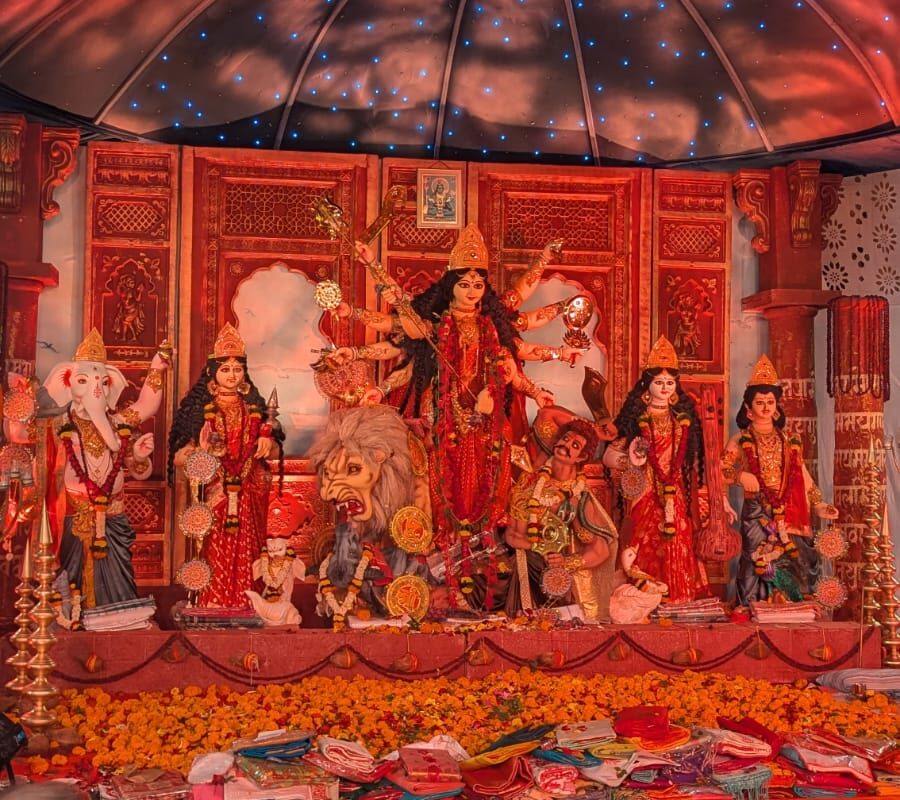
In its 97th year, BDBS has been preparing for this year’s Pujo for more than eight months. As we step into the scene in the final week of preparations, it’s all coming together. The iconic Tejpal Hall, which has hosted the BDBS pujo since 1971, is a frenzy of stalls, decorations and a main stage taking shape. One member is painting a beautiful alpana, a Bengali version of rangoli made with ground rice paste rather than coloured powder. Another is on the phone with the printers, checking on the sponsor banners. A few others are making sure everything is ready to welcome Durga Ma and her divine family when they arrive from the idol-makers.
And my role in all this? Capture it all and share it with the world via our social media.
BDBS went digital during Covid, bringing Ma into our members’ homes during lockdown. What began as a way to keep our community connected turned out to be a wonderful way of extending it, allowing people from anywhere in the world to join in our prayers and celebrations. Seeing my parents bow before the television, where Ma Durga ‘appeared’ to bless them, was amusing, to put it mildly. All my life, they’d warned me to keep my distance from the screen and stay away from the TV as much as possible. And here they were, bowing before it in reverence. Oh, the irony.
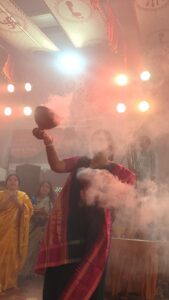
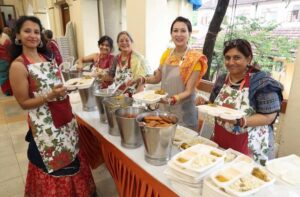
There is another role I relish more than anything else at pujo. That of serving bhog to the devotees. The ladies of BDBS come together to serve our traditional fare of khichudi-labra-payesh to around 3500 devotees a day. Over gossip, catching-up and calls of “Durga Mai ki Jai!”, we serve one plate after another to all who come to offer their prayers to the Goddess. For all the grandness of the celebrations, it is there, on my feet, serving these meals, that I feel connected to what Pujo is really about. To see the devotion in the eyes of the devotees, who so graciously accept the bhog as a way of sharing a meal with Divinity herself. This is how I am part of something much bigger than myself, of passing on, in however modest a way, a little of the blessing that brings us all together.
So, in the age of multi-hyphenated identities, these five days a year, I choose an identity I have always taken for granted. That of being a Bengali, celebrating Pujo, bowing down to the power of Ma Durga and her family, thanking Her for everything she has ever given me.
I might as well set-up the automated OOO-reply for next year’s pujo, too.
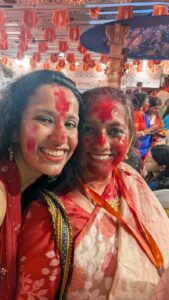
5 questions to ask your Bengali friends during pujo:
Q| Which day should I come?
All! Durga Pujo this year is being celebrated from the 16th-21st October.
While Pujo is 10-days, the main prayers and rituals span 6-days, from Panchami (the 5th day) to Dashami (the 10th and final day of the Pujo). Each day has a different significance, and you can offer Pushpanjali and offerings to the Goddess each day.
That said, Ashtami (the 8th day) is the most sacred day and the Sandhi Pujo is when we light a 108-diyas to mark the moment when Ma Durga is at her most powerful and slays Mahisasur. This year, there are 2 Ashtami days (due to Adhik Maas).
Q| Will there be food?
Loads! Pujo and food are inseparable! There will be food stalls through the morning and evening, including one by PVR at night. Bhog is being served from 12:30-2:30pm from the 17th-20th October. BDBS is a vegetarian-only pujo.
Q| What do I wear?
Dress up in your finest! We prep for pujo with 5-sets of new clothes. One for the day, another for the evening. There is a reason why Bengali families have such ornate teakwood wardrobes being passed down since generations!
There is no dress-code. So if you’re coming straight from work, come as you are. Ma Durga loves us all, just the way we are.
Q| Is Pujo open for all?
Yes, Pujo, Bhog, and the entertainment programs in the evening are open and free of cost for all!
Q| But I don’t understand Bengali! Will I still understand what is happening at Pujo?
Yes. At Pushpanjali, the pandit will lead you through the mantras. And if you’d like to understand the rituals better, just ask any of our Pujo volunteers and they’d be happy to explain more.
Tunali’s fondest memories of her childhood has been the Durga Pujo celebrations at Bombay Durga Bari Samiti. This year the pujo is from 16th-21st at Tejpal Hall, opposite August Kranti Maidan, Nana Chowk.
Also Read:
From India to the American Classroom: Swati Chopra on Design, Belonging and Keeping the Human at the Centre
From Building Global Brands to Building India’s Own: Aankith Aroraa on 3TENX
From Legacy to Launch: Sharvi Mehta on Fragrance, Business and New Beginning