
It is one of the most recognisable glow treatments in the world. A facial plastic surgeon explains what it really does for your skin, who it suits, and when your skin needs something else entirely.
There are very few aesthetic treatments that have become as recognisable as the HydraFacial. It is often described in three words: cleanse, extract, hydrate. And that description is not wrong. But it is incomplete.
Because the real question is not “Does HydraFacial make your skin glow?” It usually does. The better question is: “What is it actually doing for my skin—and is that what my skin needs?”
At ACSC, this is how I prefer to look at any aesthetic treatment. Not by how popular it is, but by whether the treatment matches the biology of the skin in front of me.
So, what is a HydraFacial actually doing?
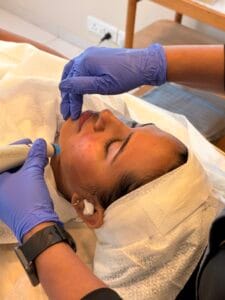
HydraFacial is essentially a form of hydradermabrasion. It combines controlled exfoliation, cleansing, extraction and the delivery of topical solutions/serums during the same treatment. The treatment uses a specialised vacuum-assisted system to loosen and remove surface debris and help clear pore contents, while hydrating solutions are simultaneously applied.
That combination explains much of its appeal. You are not simply having a facial. You are combining several relatively gentle steps into one treatment, without the downtime associated with more aggressive resurfacing procedures. The immediate result can be very satisfying: skin can look cleaner, smoother, fresher and more hydrated.
And there is some clinical evidence behind its use. Studies have reported improvement in skin appearance following hydradermabrasion, while a study of a six-treatment HydraFacial clarifying series found improvement in patients with active acne. But—and this is important—the treatment should still be viewed for what it is. It is a skin-quality treatment, not a replacement for medical treatment of every skin problem.

Who actually benefits from it?
I find HydraFacial particularly useful when the objective is skin maintenance and surface quality rather than dramatic structural change. It can be a good option for people dealing with:
– Dull or tired-looking skin
– Surface congestion and comedones
– Mild uneven texture
– Dehydrated skin
– Excessive surface oiliness
– Mild pigmentation or uneven-looking skin tone
– Skin that needs a quick refresh before an event
– Patients who want regular, low-downtime skin maintenance
It can also be useful for someone who simply feels that their skin has become “flat” or congested despite having a reasonable skincare routine. That distinction matters. Sometimes the skin does not need another strong active ingredient. It needs better surface management. And this is where a treatment such as HydraFacial can have a role.
What it cannot do?
This is where I think aesthetic medicine needs more honesty. HydraFacial will not meaningfully replace a treatment designed to remodel deeper skin structures. If someone has:
– Significant acne scarring
– Marked Laxity
– Deep wrinkles
– Significant oigmentation disorders
– Pronounced photoageing
– Facial volume loss
– Deep textural irregulations
I would not tell them that a series of HydraFacials is the answer. There are other technologies and treatments that can target these concerns more directly. For example, deeper resurfacing, radiofrequency-based treatments, lasers, injectables or medical skincare may be more appropriate depending on the diagnosis. A glow is not the same thing as collagen remodelling. And hydration is not the same thing as lifting. That distinction is particularly important in an industry where the word “rejuvenation” is sometimes used to describe almost everything.
Who should approach it with caution?
“Non-invasive” does not automatically mean “appropriate for everyone.” If the skin barrier is significantly compromised, if there is an active skin infection, open or irritated skin, significant inflammation, or if someone has recently undergone another aggressive procedure, I would generally want to assess the skin before proceeding.
The same principle applies if you are taking medications or using prescription products that make your skin unusually sensitive. For example, patients using isotretinoin or strong exfoliating/active regimens need individual assessment rather than simply following a generic facial schedule. Dermatologists specifically recommend discussing current medications and skincare products before procedures that affect the skin barrier. And if you have a specific skin disease—rather than simply “bad skin”—the first step should be a diagnosis. A facial should never be used to delay appropriate medical treatment.

What you should expect on the day?
A properly performed HydraFacial should feel more like a controlled skin treatment than a spa facial. Your skin is assessed first. The treatment generally progresses through cleansing/exfoliation, extraction and hydration, with the exact approach adapted to the patient’s skin and the treatment objective. You may experience some suction, mild tingling or a feeling of pressure during extraction.
What you should not be chasing is aggressive redness, excessive irritation or the sensation that your skin has been “scrubbed clean.” More aggressive does not necessarily mean more effective. In aesthetic medicine, I often prefer the least aggressive treatment that can achieve the intended biological effect. That is especially relevant for Indian skin, where unnecessary inflammation can sometimes create its own problems, including post-inflammatory pigmentation.
What about the famous post-HydraFacial glow?
It is real—but we should understand what it means. Part of the immediate improvement comes from removing surface debris and improving hydration, which can make the skin reflect light more evenly. That creates the characteristic fresh, polished appearance. It is one reason HydraFacial works particularly well before events.
But the glow should not be confused with permanent skin transformation. Your skin continues to age. Sebum production continues. Pigmentation can recur. Acne can recur. A good HydraFacial is therefore best thought of as maintenance, rather than a one-time correction of everything that is happening to your skin.
How often should you have one?
There is no universal “every four weeks” rule. Someone with oily, congested skin may benefit from a different schedule from someone with dry or sensitive skin. And sometimes the right answer is not to have another HydraFacial at all.
If your skin is already healthy, well-hydrated and uncomplicated, I would rather see you maintain that with appropriate skincare than create a treatment dependency simply because a calendar says you are “due” for a facial. That is also why, at ACSC, I don’t believe in prescribing procedures by package alone. The skin should determine the treatment—not the package.

My clinical take
I like HydraFacial for a very specific reason: it does something useful without pretending to do everything. For the right patient, it can be an excellent way to improve hydration, surface texture and congestion with minimal downtime. But if your primary concern is laxity, significant pigmentation, acne scarring, wrinkles or structural ageing, I would look beyond a facial.
Sometimes the best aesthetic treatment is a HydraFacial. Sometimes it is a laser. Sometimes it is injectables. Sometimes it is medical skincare. And sometimes, honestly, you don’t need a procedure at all. That last answer is just as important as the others.
Because good aesthetic medicine isn’t about doing more to the face. It is about understanding what the face actually needs—and knowing when to stop.

The ACSC approach
At ACSC, we use HydraFacial MD as part of a broader skin-health approach rather than as a standalone “glow treatment.” If you’re considering one, the most useful consultation is not “Which HydraFacial should I buy?” It is: “What is happening to my skin, and what is the most appropriate way to improve it?” That is where treatment becomes personalised—and where aesthetics becomes medicine.
Also Read:
How Ankita Gill Is Bringing the Soul of the East to Fragrance with Param Sara
Discipline, Innovation and Aminu: Prachi Bhandari on Building Steadily and Building Right
From Legacy to Launch: Sharvi Mehta on Fragrance, Business and New Beginning