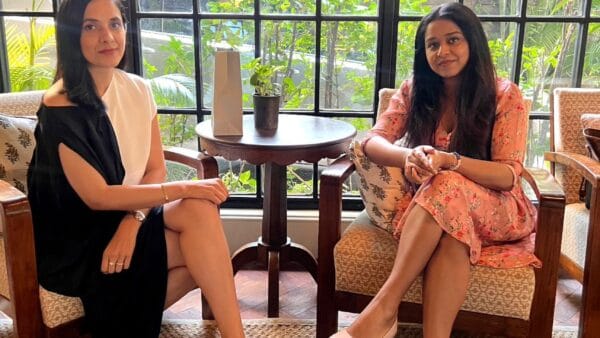

For this edition, we are joined by Swati Chopra, Associate Professor of Graphic Design at Mount St. Joseph University in Cincinnati and founder of its Design Hub.
Swati was my first friend in Gujarat. Her roots are in India, and so is the start of her journey in design. Even then, she was a live wire: full of ideas, full of laughter, and impossible to keep still. Since then, I’ve watched her carry that energy across three countries. She studied design in India, Germany and the US, and taught art in refugee camps in Germany along the way. She earned her BA in Graphic Design from the Rhode Island School of Design and her Master of Design from the University of Cincinnati’s DAAP as a Yates Scholar. She holds seven granted Boeing design patents and has designed for Johnson & Johnson’s medical devices team. Her artwork was selected for the Woman’s Art Club of Cincinnati’s 132nd juried exhibition.

And the laurels keep coming. Recently granted tenure, Swati received the Mount’s highest teaching honour in 2026, the S. Adele Clifford Award for Teacher of the Year, followed by the 2025–26 SOCHE Faculty Excellence Award, one of 52 honourees across 21 member institutions. At the Mount she founded Design Hub, a faculty-led, student-powered studio where students work with real clients before they graduate. That is where our paths crossed again, when Lavenderoom became one of its briefs.
Knowing Swati, her students must be having a lot of fun. So I was curious about the thinking behind the teacher. When I sat down with Swati, I found someone who still puts people before pixels, and conviction before compliance.
Q| You have studied and taught design across India, Germany and the US. Where do you think each culture is asking a different question of design?
India often taught me to think about design through resourcefulness, adaptation and cultural context. Germany made me think deeply about structure, systems and responsibility. In the US, the conversation often centers on innovation, individuality and impact. What I find interesting is that design becomes richer when these questions overlap. Good design is rarely just about how something looks. It is about who it serves, what it responds to, and why it matters.
Q| At the refugee camps in Germany, art became a way to communicate when language was not shared. Did that experience change your understanding of what design can do in the world?
Completely. It taught me very early that visual communication can cross barriers that language sometimes cannot. When people do not share words, they can still share images, gestures, color, making and stories. That experience changed how I see design. It is not simply a profession or an aesthetic practice. It can create connection, dignity, expression and belonging.
Q| Design education can sometimes reward the “right” answer. How do you create room for students to develop conviction, risk and an original point of view?
I try not to teach students to arrive at my answer. I want them to develop the ability to defend their own. I encourage experimentation, failure, revision and disagreement. If every student leaves a critique making exactly the change I suggested, I have probably taught them compliance rather than design. My job is to ask better questions, challenge their thinking, and help them develop enough confidence to say, “This is why I made this decision.”
Q| Design Hub brings students into contact with real clients before they enter the industry. What does that exposure reveal about the gap between good ideas and good design practice?
A good idea is only the beginning. Real clients teach students that design also involves listening, communicating, managing expectations, meeting deadlines, accepting feedback and sometimes changing something you personally love because it does not serve the client or audience. Design Hub lets students experience that while they still have faculty support. They begin to understand that professional design is not just creativity. It is creativity combined with empathy, discipline and responsibility.

Q| How did your association with Lavenderoom begin, and what interested you about bringing its brief into Design Hub?
Lavenderoom interested me because it offered students something beyond a typical classroom brief. It gave them a chance to work with a brand that connects beauty, wellbeing, identity and community. Bringing that into Design Hub meant students could think not only about visual identity, but about how a brand communicates values and creates an emotional relationship with its audience.
Q| When you brief students on Lavenderoom, how do you articulate a brand built around beauty, wellbeing and community without reducing it to an aesthetic exercise?
I ask them to start with people rather than visuals. Before choosing colors, fonts or imagery, they need to understand what the brand wants someone to feel and what kind of community it wants to create. Beauty is not simply about making something attractive. The design has to communicate trust, care, inclusivity and a sense of belonging. The aesthetic should come out of that understanding, not replace it.
Q| We are surrounded by more visual content than ever before. Has that made us more visually literate, or simply more easily impressed?
Probably both. We are exposed to an extraordinary amount of visual sophistication every day, so people recognize trends and polished imagery much faster. But seeing more does not necessarily mean understanding more. We can become very good at recognizing what looks impressive without questioning why it works, what it communicates, or whether it is meaningful. Visual literacy requires slowing down enough to ask those questions.
Q| What is the difference, to you, between taste and discernment?
Taste is personal. It is what I like. Discernment is being able to understand whether something works even when I do not personally like it. As a designer and educator, that distinction is incredibly important. Good critique cannot simply be “I like this” or “I don’t like this.” You have to understand the audience, context, intention and effectiveness of the work.
Q| With AI able to generate polished visuals almost instantly, where do you think the real value of a designer will move?
Away from simply producing visuals and toward judgment. AI can generate thousands of possibilities, but it does not remove the need to know which possibility matters, why it matters, who it serves, or what should happen next. The designer’s value will increasingly be in curiosity, research, empathy, critical thinking, storytelling, ethical judgment and the ability to frame the right problem. Making something beautiful is becoming easier. Knowing what deserves to be made is becoming more important.
Q| You’ve seen design from both sides, brands and education. If you were advising a founder choosing a designer or agency, what four questions should they ask before signing them on?
I would ask: Do they ask good questions before offering solutions? Do they understand our audience rather than just our aesthetic? Can they explain the reasoning behind their design decisions? And how do they respond when challenged or when the project changes? A beautiful portfolio matters, but the process behind the work tells you much more about what the relationship will actually be like.

Our conversation with Swati Chopra is a reminder that good design begins long before the first sketch. It begins with people: who we serve, what they need to feel, and why the work matters. From a first friendship in Gujarat to the laurels she collects today, Swati has never lost that live-wire curiosity. I hope you leave with a little of it too. Ask better questions, know the difference between taste and discernment, and have the conviction to say, “This is why I made this decision.”
Stay tuned for more thoughtful conversations from the ‘Lavenderoom Conversation Series.’
Also Read:
From Building Global Brands to Building India’s Own: Aankith Aroraa on 3TENX
How Ankita Gill is Bringing the Soul of the East to Fragrance with Param Sara
Born in Transit: 5 Lessons My Travels Taught Me as a First-Gen Beauty Founder